


I. Introduction: The Most Convenient Scapegoat in Analytics
It’s a familiar scene in countless quarterly business reviews. The charts on the screen show a dip in conversions, a spike in Customer Acquisition Cost (CAC), or stagnating user growth. After a moment of silence, someone in the room offers the explanation that is both plausible and comforting: “It’s just seasonality.”
The team nods in collective agreement. The explanation is accepted, noted in the minutes, and everyone moves on, secure in the knowledge that this downturn is a natural, external force beyond their control. But what if they’re wrong?
Let’s be clear: seasonality is a real and powerful force that undeniably impacts business performance. E-commerce brands will always see a Q4 spike; travel companies will always have a summer peak. Acknowledging these recurring patterns is a fundamental part of strategic planning.
However, in many organizations, “seasonality” evolves from a valid analytical observation into a convenient scapegoat. It becomes the default explanation for any unexpected downturn, effectively masking deeper, more controllable issues within your marketing, product, and user experience. It’s the easy answer that prevents the necessary, harder questions from being asked.
Are you sure the swings in your data are only due to the calendar, or is “seasonality” simply the most convenient explanation for a problem you haven’t diagnosed yet?
This post provides a strategic framework for stress-testing the seasonality assumption.
We will explore five common business problems that often masquerade as seasonal dips and provide an actionable diagnostic checklist to help you uncover the real drivers of your analytics volatility. It’s time to take control and separate the predictable rhythms of your market from the critical performance issues you can actively solve.
II. When It Is Seasonality: Acknowledging the Baseline
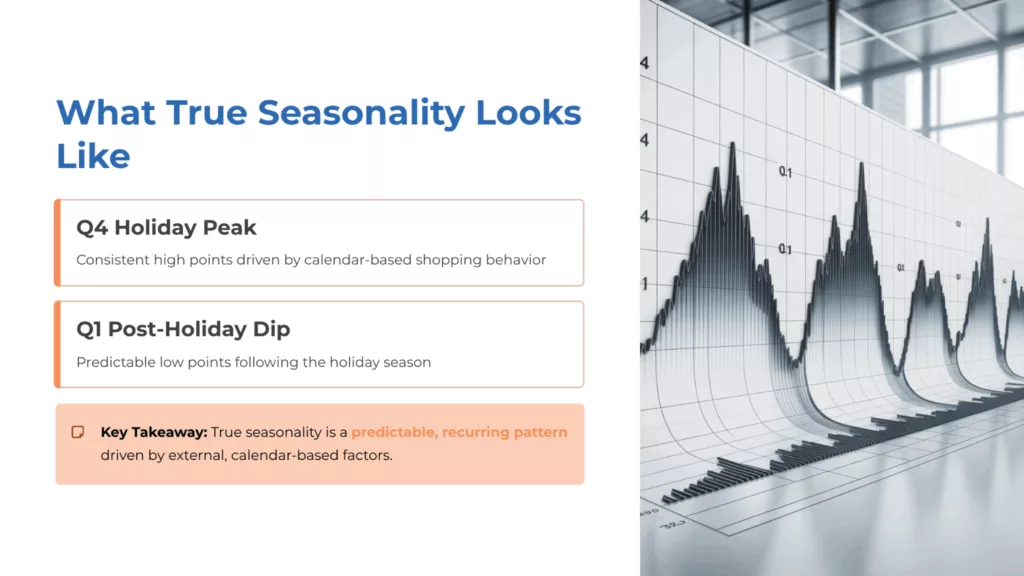
To effectively challenge the “seasonality” assumption, we first need to define what true, predictable seasonality actually looks like in your data. Seasonality is real, and acknowledging its impact is the mark of a mature business. Ignoring it is as strategically flawed as blaming everything on it.
Defining True Seasonality
True seasonality refers to predictable, recurring patterns in business performance that are tied to external, calendar-driven factors. These are the macro-level ebbs and flows that affect your entire industry or customer base. The key here is “predictable and recurring.” A one-time dip is an anomaly; a dip that happens every February is a seasonal pattern.
Common Examples of True Seasonality
Your business will have its own unique rhythm, but most seasonal patterns fall into several common categories:
- Holiday-Driven Peaks & Troughs: This is the most obvious form. An e-commerce retailer will always see a massive spike in Q4 leading up to Christmas and a corresponding dip in January. Conversely, a fitness brand might see its peak in January as New Year’s resolutions kick in.
- Weather & Climate Patterns: A travel company specializing in beach resorts will see revenue peak during summer months in its target markets. A company selling winter apparel will see the opposite.
- Academic & Fiscal Calendars: An EdTech company’s usage will spike in the fall and spring semesters and dip during the summer. A B2B SaaS company with enterprise clients might experience a slowdown in new sales cycles at the end of each quarter as budgets are finalized, or a rush of deals right before.
- Cultural Events: A company selling national flags or party supplies will see predictable spikes around specific national holidays or major sporting events.
The Correct Strategic Approach to True Seasonality
The strategy for managing true seasonality is anticipation and planning, not explanation after the fact. Data-driven organizations use historical data (comparing year-over-year performance for the same period) to:
- Adjust Marketing Budgets: Shifting spend to capitalize on high-intent peak seasons and pulling back during predictable lulls to improve efficiency.
- Manage Inventory & Staffing: Ensuring stock levels and support staff are prepared for the surge.
- Tailor Messaging: Aligning marketing and product messaging with the customer’s seasonal mindset (e.g., “gift-giving” in December, “tax prep” in March).
By acknowledging and planning for this baseline seasonal rhythm, you create the analytical clarity needed to spot deviations. When performance is worse than the predictable seasonal dip, or better than the expected seasonal peak, you know that another, more immediate factor is at play. That is where our real investigation begins.

III. When It Looks Like Seasonality… But Isn’t: 5 Hidden Problems an Expert Partner Can Uncover

When analytics show a deviation from predictable seasonal patterns, it is a signal to begin a strategic investigation.
Before your team accepts “seasonality” as the final answer, a deeper diagnostic process is required.
The following are five common, controllable business problems that are frequently misattributed to the calendar. Recognizing and addressing them is key to unlocking sustainable growth.
1. Campaign Fatigue & Offer Saturation
- The Symptom You See:
You observe a gradual but steady decline in click-through rates and conversions from your core, always-on marketing campaigns.
It’s easy to dismiss this as a “mid-season slump” or a natural cooling of market demand as a quarter progresses.
- The Hidden Problem:
This is rarely about a change in the season; it is almost always an optimization and personalization problem.
Your audience, especially in finite retargeting pools, has been overexposed to the same ad creative, the same email subject line, or the same “10% Off” offer for weeks. What was once compelling has become background noise.
This is not a dip in market demand; it is a dip in the relevance and impact of your marketing execution.
- Strategic Deep Dive:
Campaign fatigue is a measurable phenomenon. A strategic partner can help you move beyond basic campaign reporting to implement a rigorous testing and optimization rhythm.
This involves systematically rotating ad creative, testing new value propositions, and personalizing offers based on user segments.
By creating a structured experimentation framework, you can proactively combat fatigue and continuously discover what resonates with your audience now, rather than relying on what worked three months ago.
The Critical Diagnostic Question: “Have we rigorously tested and rotated our core campaign offers and creative in the last 60 days, or are we serving stale content to our audience?”
2. Inaccurate or Broken Analytics Tracking
- The Symptom You See:
A sudden, sharp, and often alarming drop in conversions or other key metrics. This can look like a dramatic, unexplainable market shift or a sudden “seasonal” cliff that doesn’t align with historical patterns.
- The Hidden Problem:
This is often not a business performance issue at all; it is an instrumentation failure. The “seasonal dip” is actually an illusion created by data loss.
Common culprits include a broken conversion event after a recent website update, a misconfigured Consent Management Platform (CMP) that is incorrectly blocking tags, or tracking scripts that are failing to load correctly.
Your business is still performing, but your ability to see that performance is broken.
- Strategic Deep Dive:
Data integrity is the absolute foundation of a data-driven business. An expert partner can help you establish a proactive data quality and auditing process.
This involves using automated tools (like ObservePoint) and manual validation to regularly audit your analytics implementation, ensuring that all key conversion events, marketing tags, and data layer variables are firing correctly across all user journeys and devices.
This transforms data monitoring from a reactive, fire-fighting exercise into a proactive, preventative discipline.
- The Critical Diagnostic Question:
“Have we performed a recent data audit to validate that all our key conversion events and marketing tags are firing correctly, or are we making decisions based on potentially incomplete data?”
3. A Fragmented Customer Journey
- The Symptom You See:
A long, slow decline in overall customer engagement, repeat purchase rates, or Lifetime Value (LTV). This trend defies normal seasonal peaks; even during your expected “good” months, the numbers are softer than the previous year.
- The Hidden Problem:
This is often a data architecture problem. Your customer experience is disjointed and frustrating because your underlying data is siloed.
Your marketing platform doesn’t know what a customer did in your mobile app, and your customer support tool has no context on a user’s recent purchase history.
As a result, your attempts at personalization are inconsistent and often irrelevant, leading to a gradual erosion of customer loyalty.
- Strategic Deep Dive:
The solution to a fragmented journey is a unified data foundation, which is the core function of a Customer Data Platform (CDP).
An expert partner can help you architect a data strategy that uses a CDP to stitch together data from all your disparate systems (marketing, product, service, etc.) into a single, unified view of the customer.
This unified profile then becomes the “single source of truth” that powers consistent, personalized experiences across all channels.
- The Critical Diagnostic Question:
“Can we track a single user’s journey from a marketing email, to our mobile app, and then to a customer support ticket in a unified view, or are we looking at separate, incomplete pictures of our customer?”
4. Channel Saturation or Inefficient Media Mix
- The Symptom You See:
A once-reliable marketing channel begins to show diminishing returns. The Cost Per Acquisition (CAC) creeps up, and the volume of conversions plateaus or declines over time.
- The Hidden Problem:
It’s rarely that the “season” for that channel has ended. The issue is a measurement and analytics strategy problem.
You have likely either saturated your addressable audience on that platform, or your media mix has become inefficient because you are optimizing for the wrong metric.
Many businesses focus on top-of-funnel CAC, a metric that says nothing about the long-term value of the customers being acquired.
- Strategic Deep Dive:
A sophisticated analytics partner can help you shift from a CAC-based optimization model to an LTV-based one.
This involves implementing a product analytics platform (like Amplitude) and connecting it to your acquisition data.
This allows you to measure the true, long-term value of users from each channel, revealing that a “high CAC” channel might actually be your most profitable one if it acquires customers who retain and spend more over time.
- The Critical Diagnostic Question:
“Are we using advanced analytics to measure the true long-term value (LTV) of users from each channel, or are we still just optimizing for top-of-funnel CAC?”
5. Poor On-Site Personalization & User Experience
- The Symptom You See:
Your website traffic is steady or even increasing, but your overall conversion rates are slowly declining. It’s easy to mistake this for a “seasonal” lack of buying intent among your visitors.
- The Hidden Problem:
This is often a CEP/Personalization engine and Conversion Rate Optimization (CRO) problem.
Your on-site or in-app experience is generic. It fails to meet the modern user’s expectation for relevance and personalization.
Everyone sees the same homepage, the same offers, and the same content, regardless of their past behavior, purchase history, or expressed interests.
- Strategic Deep Dive:
An expert partner can help you implement and leverage your first-party data to power a dynamic, personalized on-site experience.
This involves using a Customer Engagement Platform (CEP) or other personalization tools to tailor content, product recommendations, and offers to specific user segments in real-time.
This transforms a static website into a dynamic, responsive experience that adapts to each user.
- The Critical Diagnostic Question:
“Are we effectively using our first-party data to personalize the on-site experience for returning users, or is everyone seeing the same generic homepage?”
IV. A Diagnostic Checklist: How to Stress-Test Your “Seasonality” Assumption
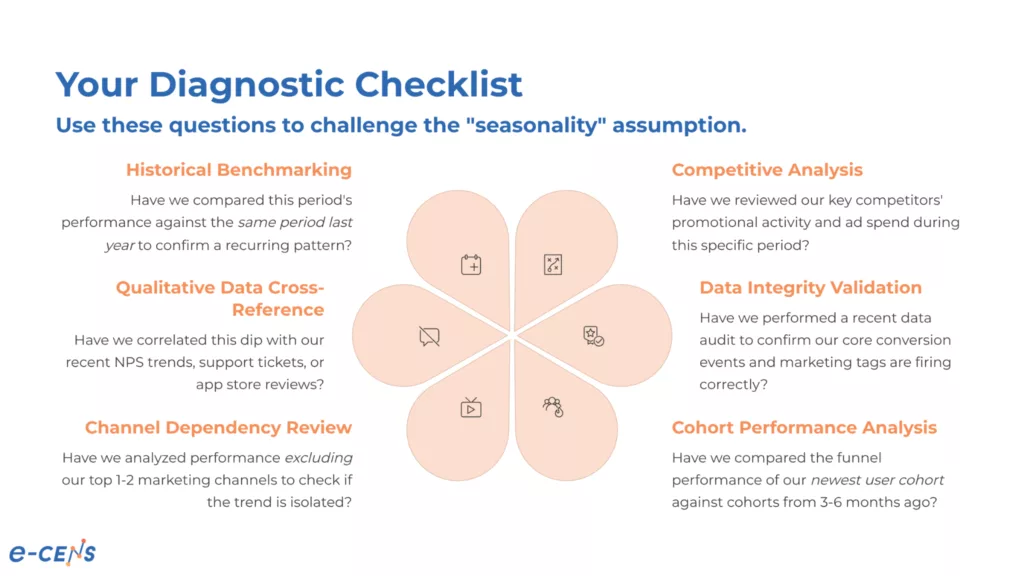
The insights from a deep analysis are powerful, but sparking that investigation requires asking the right questions. Too often, “it’s seasonality” is accepted as an answer because the team lacks a structured framework for challenging it.
Use this diagnostic checklist in your next performance review meeting. If the answer to several of these questions is “no” or “we don’t know,” it is a strong signal that deeper, controllable issues are likely being masked by the seasonality excuse. This checklist is your tool to move the conversation from passive acceptance to proactive inquiry.
Checklist Item 1: Historical Benchmarking
[ ] Have we compared this period’s performance (e.g., this October) against the same period last year and the year before to confirm a predictable, recurring pattern?
- Why it Matters: True seasonality is cyclical. A one-time dip is an anomaly, not a seasonal trend. This is the most basic, yet often overlooked, validation step.
Checklist Item 2: Competitive & Market Analysis
[ ] Have we reviewed our key competitors’ promotional activity, ad spend intensity, and messaging during this specific period?
- Why it Matters: Your performance does not exist in a vacuum. A competitor’s aggressive, well-executed campaign can directly impact your metrics, creating a dip that has nothing to do with the season.
Checklist Item 3: Data Integrity & Tracking Validation
[ ] Have we recently performed a data audit or validation to confirm that our core conversion events, marketing tags, and consent management platform are all firing correctly?
- Why it Matters: A sudden drop in reported conversions is often an instrumentation failure, not a business failure. You must trust your data before you can trust any conclusions drawn from it.
Checklist Item 4: Cohort Performance Analysis
[ ] Have we compared the conversion funnel performance of our newest user cohort against cohorts from 3-6 months ago?
- Why it Matters: This is the primary method for detecting a degrading user experience. If your new users are converting at a lower rate than your old users did when they were new, your product or on-site experience has likely developed new friction points.
Checklist Item 5: Channel Dependency Review
[ ] Have we analyzed our performance excluding our top one or two marketing channels to see if the negative trend is isolated or widespread?
- Why it Matters: This simple segmentation can quickly reveal if you’re experiencing a market-wide “seasonal” dip or if the problem is actually a channel-specific issue, such as audience saturation or an algorithm change on a single platform.
Checklist Item 6: Cross-Referencing Qualitative Data
[ ] Have we correlated this quantitative performance dip with our recent qualitative data (e.g., NPS trends, CSAT scores, support ticket themes, app store reviews)?
- Why it Matters: Qualitative data often provides the “why” that quantitative data cannot. A surge in support tickets about a specific bug or negative reviews about a new feature is a powerful leading indicator that the problem is internal, not seasonal.
If your team cannot confidently answer “yes” to most of these questions, then the “seasonality” explanation should be considered an unvalidated hypothesis, not a final conclusion. It is a signal that a deeper, more strategic investigation is required.
V. Conclusion: Taking Control of Your Growth Levers
Seasonality is a real and impactful force in any business. Acknowledging and planning for its predictable rhythms is a sign of a mature organization.
However, allowing “seasonality” to become the default explanation for every unexpected downturn is a significant strategic error. It masks opportunity, obscures real problems, and encourages a culture of passive acceptance over proactive problem-solving.
The most successful, high-growth businesses are relentless in their search for the controllable factors that drive their performance.
They treat seasonality as the known baseline upon which they operate, but they actively diagnose and address the variables they can influence: the effectiveness of their marketing creative, the integrity of their data, the friction in their customer journey, the efficiency of their channel mix, and the quality of their on-site experience.
By moving beyond the easy answer of “it’s just the season” and using a diagnostic framework like the one outlined here, you empower your team to take control.
You shift your organization’s posture from being reactive to external forces to being proactive drivers of your own growth. This is the fundamental difference between companies that are managed by their data and companies that use data to manage their business.
If you’ve asked these questions and suspect that “seasonality” might be masking deeper, more complex issues in your data, it represents a critical moment for your business. The willingness to look deeper is what separates market leaders from the rest.
Request a complimentary ‘Analytics Deep Dive’ consultation with e-CENS. In 30 minutes, our experts can help you review your data, stress-test your assumptions, and identify the key areas to investigate, determining if it’s truly seasonality or a hidden opportunity for growth.

Frequently Asked QuestionWhat is seasonality in business analytics and why is it important to recognize?
Seasonality refers to predictable, recurring patterns in business performance tied to external calendar-driven factors, such as holiday peaks, weather changes, or fiscal calendars. Recognizing true seasonality is crucial for strategic planning, allowing businesses to anticipate and prepare for natural fluctuations in demand rather than misattributing all performance changes to external forces.
How can businesses distinguish between true seasonality and other causes of performance dips?
To distinguish true seasonality, businesses should compare current performance against the same periods in previous years to confirm recurring patterns. Analyzing competitor activity, validating data integrity, reviewing cohort performance, segmenting channel impacts, and correlating qualitative feedback help identify whether dips are seasonal or caused by internal issues.
What are common business problems that are often mistaken for seasonality?
Five common problems often misattributed to seasonality include campaign fatigue and offer saturation, inaccurate or broken analytics tracking, fragmented customer journeys due to siloed data, channel saturation or inefficient media mix, and poor on-site personalization or user experience impacting conversions.
How does campaign fatigue affect marketing performance and how can it be addressed?
Campaign fatigue occurs when audiences are repeatedly exposed to the same ads or offers, leading to declining click-through rates and conversions. It is addressed by regularly rotating creative assets, testing new value propositions, and personalizing campaigns based on user segments through a structured experimentation framework.
Why is data integrity critical when analyzing seasonal trends?
Data integrity ensures that metrics accurately reflect real business performance. Sudden drops in conversions may be caused by broken tracking scripts, misconfigured consent platforms, or data loss rather than actual market changes. Regular data audits and validation of conversion events are necessary to avoid making decisions based on incomplete or faulty data.
What role does a unified customer data platform (CDP) play in understanding seasonality-related issues?
A CDP integrates data from multiple systems into a single customer view, preventing fragmented journeys and enabling consistent personalization. Without it, marketing efforts may be irrelevant or inconsistent, causing declines in engagement and lifetime value that can be mistakenly blamed on seasonality.
How can businesses improve their media mix and avoid channel saturation?
By shifting from optimizing solely on Cost Per Acquisition (CAC) to focusing on the Lifetime Value (LTV) of customers acquired from each channel, businesses can identify which channels deliver long-term profits despite higher initial costs. This advanced analytics approach prevents over-reliance and saturation of specific marketing channels.
What diagnostic questions should teams ask to challenge the assumption that a dip is due to seasonality?
Teams should ask if they have benchmarked current periods against historical data, reviewed competitor activity, audited tracking accuracy, analyzed user cohort performance, segmented channel results, and cross-referenced qualitative feedback like NPS or support tickets. Negative or unknown answers suggest a deeper investigation is needed.
How should organizations respond when they suspect “seasonality” is masking deeper problems?
Organizations should adopt a proactive investigative approach using a diagnostic framework to uncover controllable factors affecting performance — such as marketing relevance, data quality, customer journey friction, channel efficiency, and user experience — rather than accepting seasonality as the sole explanation.
What benefits do businesses gain by moving beyond seasonality as an explanation for performance changes?
By looking beyond seasonality, businesses can identify hidden growth opportunities, improve marketing effectiveness, enhance customer experiences, ensure accurate data insights, and ultimately shift from reactive to proactive management of their growth levers. This leads to sustainable competitive advantage and better decision-making.


