

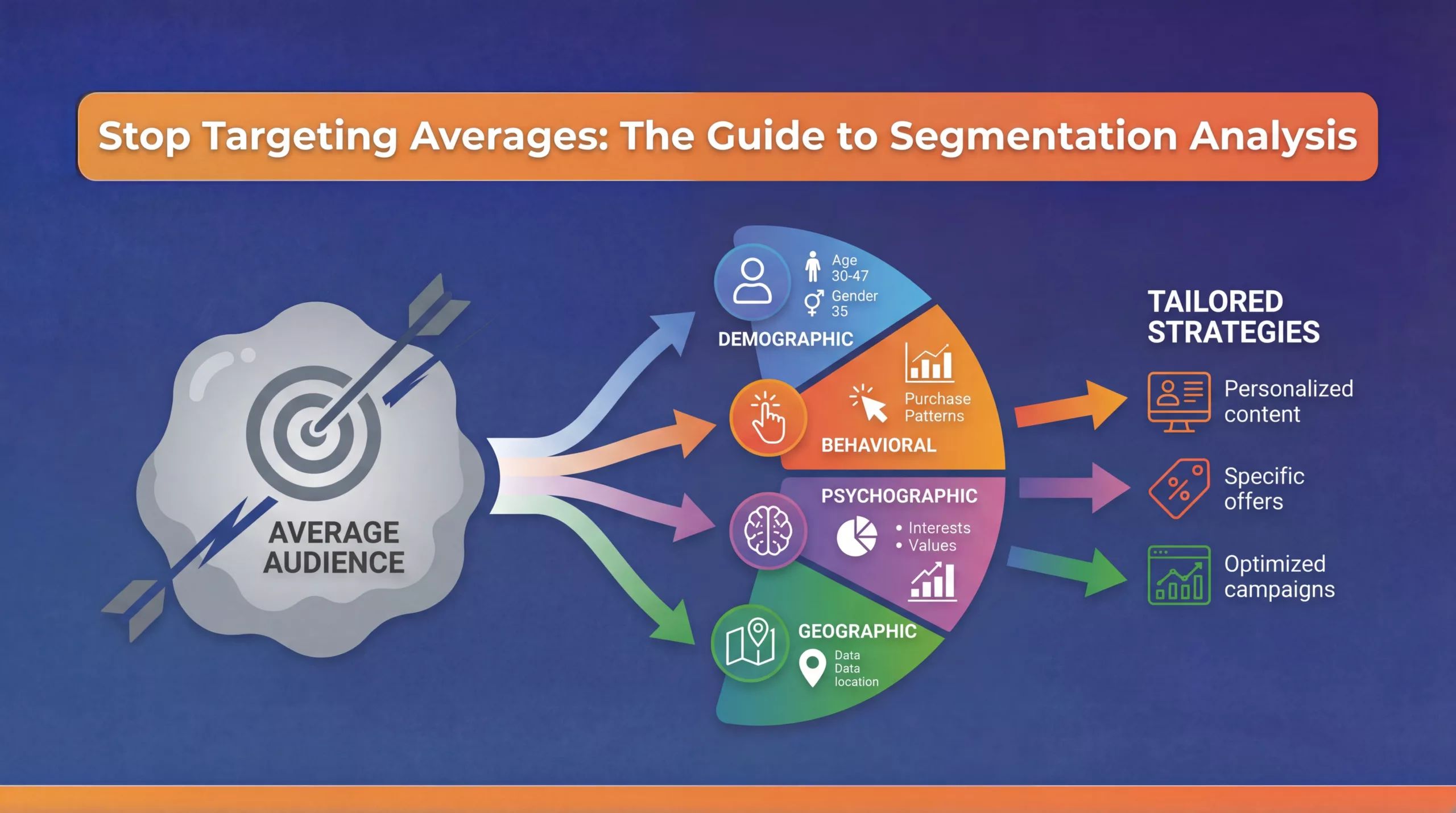
I. Introduction: The Dangerous Myth of the “Average” Customer
If you design an experience for the “average” customer, you design it for no one.
This is the fundamental flaw in traditional marketing strategies that rely heavily on demographic buckets. When you aggregate your data to find the “average” user—perhaps a 34-year-old female living in an urban area—you create a phantom. You are optimizing for a mathematical mean that likely represents a tiny fraction of your actual, revenue-generating audience.
Relying on demographics tells you who a customer is, but it fails to explain what they want, why they buy, or how much value they bring to your business.
In the current digital landscape, this lack of precision is a liability. A campaign targeting “Males, 18-35” treats a high-intent power user exactly the same as a one-time discount hunter. The result? You overspend on low-value traffic and undertarget your hidden whales. You burn budget on “reach” instead of investing in “resonance.”
The Shift to Value-Based Precision
True Segmentation Analysis is the antidote to the “average.” It is the strategic process of dividing your customer base not by their identity, but by their intent and value.
It moves you from asking “How do we reach more millennials?” to asking “How do we identify the behavioral signals that predict high Lifetime Value (LTV), and how do we suppress ad spend for users likely to churn?”
This guide is your strategic blueprint for moving beyond basic demographics. We will deconstruct the four modern layers of segmentation—Demographic, Behavioral, Psychographic, and Value-Based—and provide a methodology for clustering your audience into actionable, revenue-driving groups. We will explore how to operationalize these segments for media efficiency, personalization, and product development, turning your noisy customer database into your most valuable strategic asset.
II. The 4 Layers of Modern Segmentation
Data is not created equal. A customer’s zip code does not have the same predictive power as their purchase frequency. To architect a winning strategy, you must understand the four layers of customer data and how to apply them.
Layer 1: Demographic (The Identity)
This is the baseline. It includes Age, Gender, Location, Job Title, and Company Size.
- The Utility: Demographics allow you to set the boundaries of your market. If you sell luxury winter coats, targeting users in tropical climates is wasteful. If you sell enterprise software, targeting college students is inefficient.
- The Limitation: Identity is not intent. Knowing a user is a “35-year-old CTO” does not tell you if they are currently looking for a new data platform or if they are happy with their incumbent. Relying solely on Layer 1 leads to broad, expensive “spray and pray” campaigns.
Layer 2: Psychographic (The Mindset)
This layer addresses the “Why.” It categorizes users based on their values, interests, lifestyles, and attitudes. Are they “Early Adopters” or “Skeptics”? Are they “Price-Conscious” or “Quality-Driven”?
- The Utility: Psychographics drive creative strategy. They tell you how to speak to the user. A message emphasizing “Security and Risk Reduction” appeals to one psychographic segment, while “Innovation and Speed” appeals to another, even if the demographic profile is identical.
- The Limitation: This data is difficult to capture directly without surveys or qualitative research. It is often inferred rather than observed, which introduces a margin of error.
Layer 3: Behavioral (The Action)
This is where digital analytics provides a distinct advantage. Behavioral segmentation tracks what users actually do. It looks at:
- Content Consumption: Did they read three blog posts on “Data Governance”?
- Feature Usage: Do they use the “Export” function daily?
- Engagement: How often do they log in?
- The Utility: Behavior is the strongest signal of intent. A user who visits your “Pricing” page three times in one week is signaling a high readiness to buy, regardless of their age or job title. This layer allows for trigger-based marketing that responds to the user’s immediate needs.
Layer 4: Value-Based (The Bottom Line)
This is the most critical layer for profitability. It segments users based on their financial contribution to the business. The gold standard here is RFM Analysis:
- Recency: How recently did they buy?
- Frequency: How often do they buy?
- Monetary: How much do they spend?
- The Utility: This separates your “Whales” from your “Minnows.” It allows you to invest heavily in retaining your top 1% of customers while automating low-cost interactions for low-value users. It aligns your marketing spend directly with customer lifetime value (LTV).
The Strategic Synthesis
The goal is not to choose one layer. The goal is to combine them.
A powerful segment looks like this: “CTOs in the UK (Demographic) who value security (Psychographic), have visited our API documentation (Behavioral), and have a potential contract value of $100k+ (Value-Based).”
When you combine these layers, you stop targeting a generic audience. You start targeting a specific revenue opportunity.
III. The Methodology: How to Conduct a Segmentation Analysis
Effective segmentation is not a data mining exercise. It is a scientific process. It requires you to form a hypothesis, test it against the data, and validate the results.
Step 1: Hypothesis Generation
Do not start by opening your analytics tool. Start with a business question.
If you simply “look for trends,” you will find correlations that do not matter. Instead, frame a specific question about user value.
- Example: “Do users who read our technical documentation have a higher retention rate than those who only visit the pricing page?”
- Example: “Does our mobile app audience spend more per transaction than our desktop audience?”
This hypothesis focuses your analysis. It tells you exactly which data points to pull. It ensures that the resulting segment helps you make a decision.
Step 2: Clustering and Data Mining
Once you have your question, you must identify the users who fit the criteria. This is the technical phase.
You look for “clusters” of users who exhibit similar behaviors. You can do this using standard tools like Google Analytics 4 (GA4) or Amplitude for behavioral clustering. For deeper analysis, data science teams might use SQL or Python to group users based on statistical similarities in their purchase history.
The goal is to find distinct groups. You want to find Group A, which behaves one way, and Group B, which behaves differently. If the groups act the same, your hypothesis was wrong. You must start over.
Step 3: Profiling and Naming
A list of User IDs is not a segment. To make the data useful for marketing, you must humanize it. You need to build a “Data-Driven Persona.”
Look at the cluster you identified. What else do they have in common?
- Do they mostly come from organic search?
- Do they buy primarily on weekends?
- Do they purchase specific product categories?
Give the segment a descriptive name. Instead of “Cohort 4,” call them “The Weekend Researchers” or “High-Value Techies.” Naming the segment makes it real for your creative team. It helps them write copy that speaks to that specific mindset.
Step 4: Statistical Validation
This is the most critical step. You must prove that your segments are mathematically distinct.
Compare the Key Performance Indicators (KPIs) of your new segment against the general population.
- Is their Conversion Rate significantly higher?
- Is their Average Order Value different?
- Is their Churn Rate lower?
If “The Weekend Researchers” convert at 2.5% and your site average is 2.4%, this is not a valid segment. It is statistical noise. It is not worth a dedicated budget.
However, if they convert at 6.0%, you have found a goldmine. You have validated a high-value audience that deserves a distinct strategy.

IV. Strategic Application: Activation
The ultimate goal of segmentation is not categorization. It is discrimination. You must treat different customers differently.
Once you have validated your high-value and low-value segments, you must inject them into your operational stack. You need to push these definitions into your ad platforms, your personalization engines, and your product roadmaps.
We apply these segments across three primary vectors to drive revenue.
1. Personalization: The Right Message for the Right Value
Most websites serve a static experience. The homepage looks the same for a first-time visitor as it does for a customer who has spent $5,000 in the last year. This is a missed opportunity.
With value-based segmentation, you can alter the digital experience based on the user’s tier.
- For the “High-Value Loyalist”: When they arrive on the site, do not show them a generic “10% Off” pop-up. They are already sold on your brand. Instead, show them a “VIP Early Access” banner for your new product line. Remove friction. Recognize their status.
- For the “Price-Sensitive Browser”: This segment has visited high-intent pages but abandoned the cart multiple times. They need a nudge. Serve them a time-sensitive discount code or a free shipping offer. You are trading margin for conversion, but only for the specific group that requires it.
This dynamic approach increases conversion rates because it aligns the incentive with the user’s specific motivation.
2. Media Efficiency: The Power of Suppression
Marketing budgets are finite. The fastest way to improve Return on Ad Spend (ROAS) is not just finding better customers. It is stopping the spend on bad ones.
Your segmentation analysis identified the “Low-Value Churn Risk” or the “One-and-Done” customers. These are users who cost more to acquire than they return in lifetime value.
You must export these lists to Google Ads and Meta (Facebook). You apply them as Suppression Lists.
You tell the platforms: “Do not bid on these people.”
By removing the bottom 20% of your audience from your paid campaigns, you instantly free up budget. You can then reallocate those funds to bid more aggressively on “Lookalike Audiences” modeled after your “High-Value Whales.” You are no longer paying to acquire customers who lose you money.
3. Product Development: Building for the Best
Segmentation should also inform what you build. Product teams often fall into the trap of building features requested by the “loudest” users. Often, the loudest users are not the most profitable ones.
If you analyze feature usage by segment, you might find that your “High-Value Enterprise” segment relies heavily on a specific reporting tool that has been neglected. Meanwhile, your “Free Tier” users are complaining about a cosmetic dashboard widget.
Strategic product management means prioritizing the features that retain your best customers. You build for value, not volume. You align your roadmap with the needs of the segments that drive your revenue.
The Feedback Loop
Activation is not a one-time event. It is a cycle. You deploy a campaign to “The Weekend Researchers.” You measure the results. If they do not convert, you refine the definition of the segment or you change the offer.
This continuous testing allows you to sharpen your targeting over time. It turns your customer database into a living engine of growth.
V. Conclusion: Precision Drives Profit
Treating every customer the same is a losing strategy. It wastes budget on users who will never convert. It annoys high-value customers with irrelevant messaging. It dilutes your brand.
By moving beyond basic demographics and adopting behavioral and value-based segmentation, you turn a noisy database into a structured asset. You gain the ability to speak directly to the needs of your most valuable users while ignoring the rest.
This precision is the foundation of modern marketing efficiency. It allows you to bid higher for the right traffic. It helps you design products that retain your best clients. It aligns your operational resources with your revenue drivers.
Implementing a sophisticated segmentation strategy requires more than just data. It requires a partner who can translate analytics into business logic.
Are you treating every customer the same?
Your database holds hidden revenue opportunities waiting to be found. Contact e-CENS today. Let us help you build a Segmentation Strategy that turns raw data into a distinct competitive advantage.


