
I. Introduction: Hitting the Ceiling of Standard Google Ads
For the vast majority of businesses, Google Ads is the undisputed engine of digital growth. It is accessible, powerful, and effective at capturing intent. However, for scaling enterprises, large retailers, and global brands managing millions in ad spend, that engine eventually hits a hard limit.
The problem is rarely a lack of specific features in the standard tool. The problem is a surplus of complexity in your operations. As you expand into new markets and diversify your media mix, you reach a tipping point. Your team begins to spend more time managing the logistics of the platforms than they spend on market strategy.
Consider the daily reality for a team managing a complex portfolio without an enterprise management layer. They log into Google Ads to optimize bids for their primary market. Then, they must log into Microsoft Advertising to replicate those logic changes for a different demographic. They might then move to Yahoo or Baidu for international coverage.
Reporting becomes a manual nightmare. It involves exporting CSV files from three or four different sources and spending hours manually stitching them together in a spreadsheet to get a clear view of performance. Data remains siloed within each individual publisher, making cross-channel attribution nearly impossible.
This is operational drag.
It is the silent killer of ROI at the enterprise level. When your most expensive talent spends twenty hours a week on data entry and manual aggregation instead of strategic analysis, your growth stagnates. When the management of the tool costs you more in efficiency and missed opportunity than the tool itself, you have hit the ceiling.
This post serves as a strategic guide to recognizing that inflection point. We will look beyond simple feature lists to answer the critical business question: When is your organization truly ready to move to Search Ads 360 (SA360)?
We will explore how this component of the Google Marketing Platform transforms paid search from a series of siloed tasks into a unified, enterprise-grade strategy. We will examine the specific operational signals that indicate you are ready for an upgrade, and we will break down the financial reality of making the switch.
II. Defining the Architecture: The “Manager of Managers”
To make the right investment decision, you must first understand where Search Ads 360 (SA360) fits in your technology stack. Many marketers mistakenly view it simply as “Google Ads with more features.” This is a fundamental misunderstanding of the architecture.
Think of Google Ads as a direct buying engine. It is built to purchase inventory specifically on Google properties, such as Search, Shopping, and YouTube. It is excellent at this specific task. It provides deep controls for Google-specific formats.
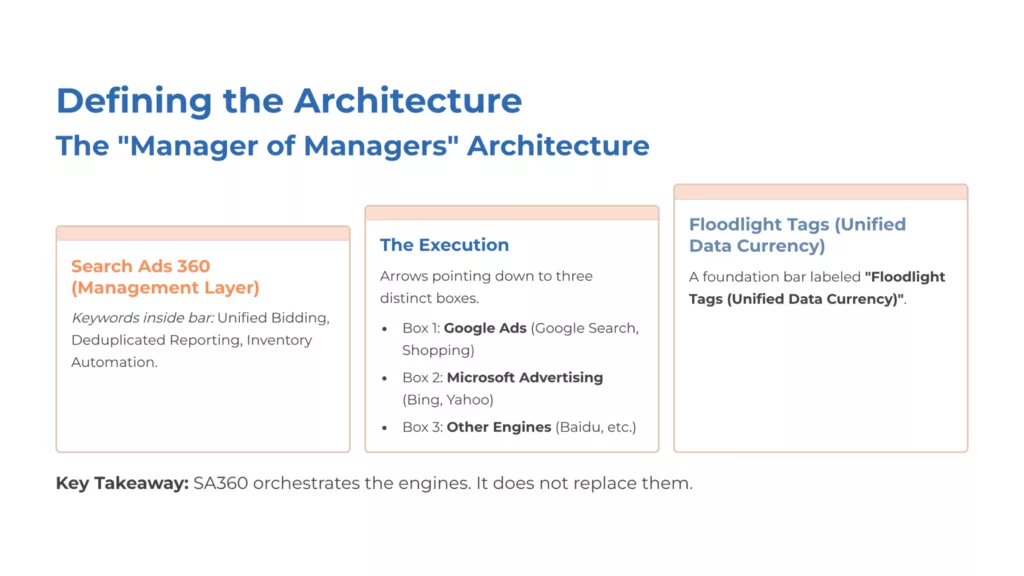
Search Ads 360 acts as a centralized management layer that sits above the individual search engines. It is the “manager of managers.” It does not replace the individual engines. It orchestrates them.
The Core Distinction: Scope and Scale
The primary difference lies in the scope of control.
- Google Ads manages Google inventory. It is a closed environment.
- Search Ads 360 manages Google Ads, Microsoft Advertising (Bing), Yahoo, Baidu, and other engines from a single interface.
This architecture allows enterprise teams to apply a single strategy across the entire search environment. You set a business goal once. The platform then executes it across every publisher. This unification is the defining characteristic of the Google Marketing Platform for search. It changes the job description of your search team from “platform operators” to “market strategists.”
From Disconnected Data to a Unified Currency
The most significant architectural shift comes from how success is measured. In a standard setup, Google Ads measures conversions using its own pixel. Microsoft Advertising uses the UET tag. These are two different languages. They count conversions differently and attribute value based on different logic. Aggregating them requires manual translation.
SA360 introduces a universal currency called Floodlight.
By placing Floodlight tags on your site, you track conversions in a single, standardized way across all engines. This creates a “single source of truth” for your data. When you log into SA360, you are not looking at Google’s definition of a sale versus Microsoft’s definition. You are looking at your business’s definition of a sale applied consistently to every click. This standardization is the prerequisite for enterprise-grade optimization.
III. The 4 Strategic Signs You Are Ready for the Upgrade

How do you determine when the investment in SA360 is justified? It is rarely about a specific budget threshold. It is about the complexity of your ecosystem. If your team faces these four challenges, you are likely ready for the enterprise tier.
1. The “Cross-Engine” Fragmentation Problem
Consider the workflow of your search managers. If they spend their mornings logging into Google Ads, then Microsoft Advertising, and finally Yahoo or Baidu to make similar adjustments, you have a fragmentation problem. Reporting is isolated. Attributing value across these platforms requires manual spreadsheet work.
This fragmentation creates data blindness. You cannot easily see if a user clicked a Bing ad yesterday and converted on a Google ad today. You likely attribute that conversion to Google alone, ignoring the role Microsoft Advertising played in the assist.
SA360 solves this by unifying your reporting and conversion tracking. You tag your site once with Floodlight tags. These tags track conversions for all engines. This gives you a single, deduplicated source of truth. You can see the entire path to conversion across different publishers. This allows you to attribute value correctly rather than double-counting sales.
2. The Bidding Intelligence Gap
Standard Google Ads bidding is powerful. However, it is limited to Google’s own inventory. When you buy on Microsoft Advertising using their native tools, you are limited to their bidding algorithms.
SA360 introduces a proprietary technology called Auction-time Bidding. This feature applies Google’s advanced machine learning to every supported search engine.
It analyzes real-time signals such as device, browser, location, and operating system at the exact moment of the query to adjust bids. This allows you to apply a sophisticated bidding strategy across your entire search portfolio, not just Google. You gain the ability to optimize bids on Microsoft Advertising using the same intelligence you use on Google. This parity is critical for maximizing return on ad spend (ROAS) in a competitive market.
3. The Inventory Management Challenge
For large retailers with thousands of SKUs, aligning ad copy with inventory is a constant struggle. Running ads for out-of-stock products wastes budget. It frustrates customers. It damages brand perception.
SA360 addresses this with Inventory Management. You connect your product feed directly to the platform. It automatically creates campaigns, keywords, and ad copy based on your real-time stock levels and pricing.
Imagine a flash sale where 500 items go out of stock in an hour. A human team cannot pause 500 specific ads fast enough to save budget. SA360 pauses those ads immediately. If a new product arrives, the ad is created automatically based on templates you define. This automation guarantees your spend always aligns with your actual inventory.
4. The Need for “Full Picture” Attribution
Search does not happen in a vacuum. Your customers see your display ads via Display & Video 360 (DV360) and your search ads. Standard Google Ads cannot easily see the impact of your display campaigns.
Because SA360 is part of the Google Marketing Platform, it shares the Floodlight tag with DV360. This creates a connected view of conversion. You can see how display views influence search clicks. You can create audiences of users who clicked a search ad and target them with display. You can do the reverse. This connection is necessary for measuring the true impact of your media mix.
IV. At a Glance: Google Ads vs. Search Ads 360
Visualizing the difference in capabilities helps clarify the strategic value. While Google Ads is a powerful execution tool, SA360 is a comprehensive management platform.

This matrix reveals the core limitation of the standard tool. It is designed to maximize Google’s revenue. SA360 is designed to maximize your revenue across the entire market.
V. The Reality Check: Migration Is Not Automatic
We must be transparent about the operational shift. Moving to SA360 is a significant undertaking. It is not a simple “on” switch. It requires a deliberate implementation phase and a commitment to change management.
The Implementation Curve
The foundation of SA360 is the Floodlight tag. To unlock the platform’s power, you must retag your site. You cannot rely on your old Google Ads pixels. This requires coordination with your web development team and a strict validation process. If the tags are not firing correctly, the bidding algorithms have no data to learn from. The setup phase is rigorous. It demands attention to detail.
The Skill Gap
Your team knows Google Ads. They likely know it inside and out. SA360 has a different interface. It uses different workflows. It introduces new concepts like “formula columns” and “business data tables.” There is a learning curve.
The teams that fail are the ones that buy the license but never invest in training. They end up using SA360 like a glorified reporting tool rather than an automation engine. They pay enterprise fees for standard performance.
To succeed, you must treat this as a re-skilling opportunity for your workforce. You are moving them from tactical execution to strategic oversight. This transition requires time and structured enablement.
This is why working with a partner is often necessary. You need a guide to set up the architecture correctly from day one. This allows your team to focus on strategy while the partner handles the technical migration.
VI. The ROI Calculation: Is It Worth the Cost?
Making the move to an enterprise platform involves a shift in your financial model. Unlike standard Google Ads, where the tool is free and you pay only for media, the enterprise platform carries a technology fee. This is typically calculated as a percentage of your total media spend.
The decision rests on whether the efficiency and performance gains outweigh this new line item. The value equation typically relies on three specific areas.
1. Operational Efficiency Gains
Quantify the hours your team spends manually logging into different engines, aggregating data into spreadsheets, and normalizing reports. SA360 removes this manual layer. By centralizing management and automating reporting, you free up significant hours. This allows your expensive talent to focus on market strategy rather than data entry.
2. Performance Uplift from Smart Bidding
The most direct return usually comes from Auction-time Bidding. By applying Google’s advanced machine learning to your non-Google spend (Microsoft, Yahoo), you often see an immediate improvement in Return on Ad Spend (ROAS). Seeing a 10% to 15% efficiency gain across your portfolio is common. This performance boost often pays for the platform fee itself.
3. Data Integrity and Budget Protection
Bad data leads to wasted budget. Without a unified view, you are likely double-counting conversions across search engines and display campaigns. SA360 provides a deduplicated view of conversion reality. It stops you from over-investing in channels that claim credit for the same sale. This precision protects your budget. It guarantees every dollar works harder.
VII. Conclusion: A Maturity Milestone
Upgrading to Search Ads 360 is not just a software purchase. It is a milestone in your organization’s growth. It signals that your paid search operation has outgrown isolated management. You are ready to manage your entire search portfolio as a single, unified system.
The shift allows your team to stop fighting with spreadsheets. They can start focusing on market strategy. It connects your search data to your display data. This gives you a complete view of the path to purchase.
The Google Marketing Platform is powerful. It is also complex. Navigating this system often requires a guide to avoid common pitfalls and setup errors.
Whether you need an audit of your current performance or training on how to apply SA360’s advanced features, e-CENS is ready to help. As a certified GMP partner, we have the expertise to guide your upgrade. We help you turn your search spend into a distinct competitive advantage.
Ready to unify your search strategy? Contact e-CENS today for a strategic GMP assessment.

Frequently Asked QuestionWhat is the main limitation of using standard Google Ads for large enterprises and global brands?
For scaling enterprises managing millions in ad spend, standard Google Ads hits a hard limit due to operational complexity. Teams spend excessive time managing multiple platforms separately, leading to inefficiencies and fragmented reporting, which ultimately hinders growth and ROI.
How does Search Ads 360 (SA360) differ architecturally from Google Ads?
Unlike Google Ads, which manages inventory only on Google properties, Search Ads 360 acts as a centralized management layer above multiple search engines including Google Ads, Microsoft Advertising, Yahoo, and Baidu. It orchestrates campaigns across all platforms from a single interface, enabling unified strategy execution and reporting.
What is the role of Floodlight tags in Search Ads 360?
Floodlight tags provide a universal currency for conversion tracking across all search engines managed by SA360. They standardize how conversions are measured and attributed, creating a single source of truth for performance data that removes discrepancies between different publisher pixels.
What are the key operational challenges indicating readiness to upgrade from Google Ads to SA360?
Four strategic signs indicate readiness: 1) Cross-engine fragmentation where teams manage multiple platforms separately; 2) Bidding intelligence gaps due to limited bidding algorithms outside Google; 3) Inventory management challenges for large retailers needing real-time ad alignment with stock; 4) The need for full attribution that connects search and display campaigns across the Google Marketing Platform.
How does Auction-time Bidding in SA360 improve campaign performance?
Auction-time Bidding applies Google’s advanced machine learning to all supported search engines in real time, adjusting bids based on signals like device, location, and browser at the exact moment of the query. This enables sophisticated bid optimization across platforms beyond Google, often improving return on ad spend by 10% to 15%.
What benefits does SA360’s Inventory Management feature provide for retailers?
Inventory Management connects product feeds directly to SA360 to automatically create or pause campaigns based on real-time stock levels and pricing. This automation prevents wasted spend on out-of-stock items and ensures ad copy always aligns with current inventory without manual intervention.
Why is full attribution across search and display important, and how does SA360 facilitate this?
Full attribution is crucial because customers interact with both search and display ads along their purchase journey. SA360 shares Floodlight tags with Display & Video 360 (DV360), enabling a connected view of conversions. This allows marketers to measure the true impact of their media mix and create audiences that move between search and display targeting.
What operational changes should teams expect when migrating to Search Ads 360?
Migration requires retagging the website with Floodlight tags, a rigorous setup process involving web development and validation, and a steep learning curve for new workflows like “formula columns” and “business data tables.” Success depends on investing in training to shift teams from tactical execution to strategic management.
How should companies evaluate the ROI of switching to Search Ads 360?
ROI evaluation involves weighing the platform fee against operational efficiency gains from centralized management, performance uplift from smart bidding (often 10%-15% better ROAS), and improved data integrity that protects budgets from wasted spend and double-counting conversions.
What does upgrading to Search Ads 360 signify for an organization’s paid search maturity?
Upgrading to SA360 marks a milestone where paid search management evolves from isolated platform operations to unified, enterprise-grade strategy. It enables teams to focus on market strategy rather than manual data work, providing a complete view of customer paths and maximizing marketing impact.