
I. Introduction: The “Split Brain” Problem in Digital Advertising
In many enterprise marketing organizations, a fundamental disconnect exists. It is not a lack of talent or budget. It is a structural flaw in how media is managed and measured.
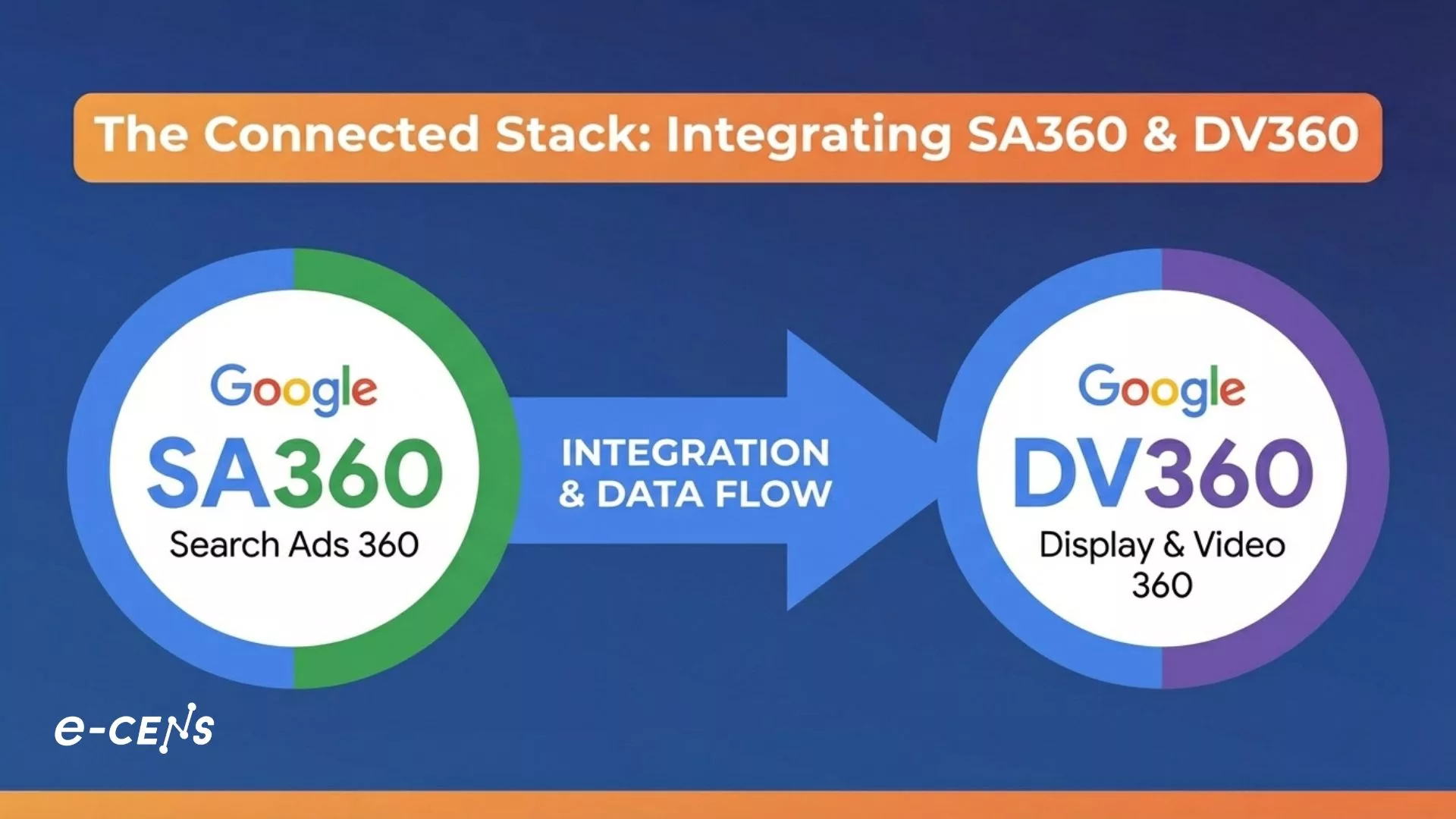
Picture the typical setup. On one side of the building, you have the Performance Search team. They live inside Google Ads and Search Ads 360 (SA360). Their world is defined by explicit intent. They capture users who are actively raising their hands and asking for a product. They measure success in Cost Per Click (CPC) and Return on Ad Spend (ROAS).
On the other side, often in a completely different department or managed by a separate agency, is the Programmatic Display and Video team. They operate within Display & Video 360 (DV360). Their mandate is different. They are tasked with generating demand, building brand awareness, and retargeting users who visited the site but did not convert. They speak the language of CPMs, reach, and viewability.
These two teams are targeting the exact same human being. Yet, they operate as if they are marketing to two different people.
This is the “Split Brain” problem.
The Search team has no visibility into whether a user who just clicked a paid text ad was previously exposed to a premium video ad bought by the Programmatic team. The Programmatic team is bidding to show display ads to users without knowing if those users have already converted via a search campaign five minutes ago.
The Strategic Cost of Isolation
The financial consequences of this isolation are severe. When your search and display stacks do not communicate, three damaging things happen immediately.
First, you pay to acquire the same user twice. Without a unified frequency cap or exclusion list, you might bombard a user with display ads moments after they have already transacted via search. This is wasted media spend that irritates the customer.
Second, you suffer from attribution blindness. If you rely on the native reporting of each platform in isolation, both platforms will claim credit for the same conversion. The Display platform claims credit because the user saw a banner. The Search platform claims credit because the user clicked a link. When you aggregate your reports at the end of the month, the sum of your conversions exceeds your actual sales figures. You are left trying to reconcile math that will never add up.
Third, and perhaps most critically, you miss the opportunity to use intent signals from one channel to inform the other. Search data is the strongest signal of intent available. Display inventory is the most scalable way to reach users. Keeping these capabilities separate prevents you from executing a truly sophisticated audience strategy.
The Promise of the Connected Stack
The Google Marketing Platform (GMP) was engineered specifically to solve this architectural flaw. However, simply buying licenses for SA360 and DV360 does not solve the problem. Ownership is not integration.
The true power of the enterprise stack lies in the connection between these tools. It is the ability to share a single definition of a conversion, a single audience pool, and a single set of attribution logic across your entire media buy.
This post serves as a comprehensive architectural guide to building that connected stack. We will move beyond the basics of platform setup to explore the advanced integration strategies that turn SA360 and DV360 into a single, unified engine. We will explore how to establish a common data currency, how to execute cross-channel audience strategies, and how to finally achieve a “single source of truth” in your reporting.
We are moving from tactical ad buying to strategic ecosystem management.
II. The Shared Currency: Understanding Floodlight Tags
Before you can integrate your bidding strategies or audience lists, you must integrate your measurement. If SA360 measures success using one ruler and DV360 uses another, you will never achieve alignment. You will spend your quarterly business reviews arguing about which set of numbers is correct.
In a standard, non-enterprise setup, this is exactly what happens. You place a Google Ads conversion tag on your “Thank You” page to track search. You place a separate pixel from a DSP or ad network to track display.
These two tags operate in isolation. When a user converts, both tags fire. Both platforms claim 100% credit for the sale. This creates a data environment filled with noise and duplication.
To solve this, the Google Marketing Platform uses a shared measurement system called Floodlight.
Floodlight is the Common Language
Think of Floodlight not just as a tracking pixel, but as a shared language for your entire media stack. It allows SA360 and DV360 to read from the same ledger.
When you deploy a Floodlight tag configuration, you are telling every tool in the ecosystem to look at the same signal. When a conversion happens, it is recorded once. That single record is then made visible to both your search management platform and your display buying platform simultaneously.
This shared architecture enables three critical capabilities that are impossible with disparate tags.
1. True De-Duplication
This is the immediate financial benefit. Floodlight allows you to define a hierarchy of credit.
Consider a common user journey. A customer sees a brand awareness video bought through DV360 on Monday. They click a display banner on Wednesday. Finally, they search for your brand and click a paid search ad on Friday to purchase.
In a siloed setup, your Display report claims one conversion. Your Search report claims one conversion. Your finance team sees only one transaction in the bank.
With Floodlight, the system recognizes this is the same user. Based on your attribution model, it assigns credit appropriately across the stack. It might give the final credit to Search while recording an “assisted conversion” for Display. The total count remains accurate. You stop reporting phantom revenue.
2. Consistent Data Taxonomy
Floodlight allows you to pass custom data parameters—known as u-variables—along with the conversion. You can pass the SKU, the transaction value, the customer type (new vs. returning), or the profit margin.
Because this tag is shared, both your Search and Display teams receive the exact same business context. Your Display team can optimize toward high-margin SKUs using the same data definitions as your Search team. You are no longer translating “Goal 1” in one platform to “Event A” in another. The definitions are standardized at the source.
3. The Foundation of Unified Reporting
Reporting is often the biggest time sink for enterprise teams. When you use separate tags, you must export data and mash it together in Excel/Sheets. You have to manually remove duplicates.
With Floodlight, you have a native, unified data set. You can pull a report that shows the total performance of a campaign across both Search and Display side-by-side, without manual intervention. This data availability allows your analysts to spend time finding insights rather than cleaning rows and columns.
Moving to Floodlight is the technical prerequisite for the advanced strategies we will discuss next. It creates the trust required to automate your media buying.

III. Three Strategic Plays for the Connected Stack
Integration is not the goal. Performance is the goal. Connecting your search and display stacks creates a feedback loop. Intent signals from one channel should inform the tactics of the other.
When you treat these platforms as a single ecosystem, you unlock three distinct strategic capabilities.
Play 1: Search Intent Driving Display Targeting
The strongest signal of consumer intent is the search query. When a user types “best enterprise crm software” or “luxury suv lease deals” into Google, they are declaring their immediate need.
In a siloed setup, if that user clicks your search ad but does not convert, that signal is often lost. You might retarget them generically, but you lose the specificity of their query.
With the connected stack, you can execute Search-to-Display remarketing.
Here is the workflow. You create an audience list in SA360 based on specific search queries or clicked keywords. A user searches for a high-margin product category. They click your ad. They do not buy.
Because the platforms are linked, this audience list is immediately available in DV360.
Your Programmatic team can now target that specific user on premium news sites or connected TV with creative that matches their exact search intent. You are not guessing what they are interested in based on third-party data. You are targeting them based on the specific words they typed into a search engine hours earlier. This precision drastically reduces wasted impressions in your display campaigns.
Play 2: Display Exposure Informing Search Bidding
The influence also flows in the other direction. Display advertising is often tasked with generating demand. You run video ads or high-impact banners to make users aware of your brand.
In a standard setup, the search team bids blindly. They treat every user searching for your brand terms the same. They do not know if a user is searching because they just saw a million-dollar video campaign or if they found you randomly.
The connected stack solves this through Display-to-Search recency.
SA360 can read the cookie data from DV360. It knows if a user searching for your brand has been exposed to a display ad or video ad in the last 48 hours.
You can create a bid strategy that accounts for this “priming” effect. If a user has seen your premium video content and then searches for your brand, they are a highly qualified prospect. You do not want to lose them to a competitor bidding on your brand name. You can instruct SA360 to apply a bid multiplier for that specific user. You ensure you own the top position for the prospects you have already paid to educate.
Play 3: Unified Attribution and Budget Fluidity
The most difficult question for a CMO is where to cut budget. If you cut display spend, does search volume drop? In a fragmented environment, this is a guessing game. Search gets all the credit because it is usually the last click. Display looks inefficient because it is often an early assist.
When you connect the stack, you unlock Data-Driven Attribution (DDA) across the entire path.
Google’s algorithms analyze the complete journey. They look at the converting paths and the non-converting paths. They assign fractional credit to every touchpoint.
You might discover that your “inefficient” prospecting campaign in DV360 is actually the primary driver of your branded search volume. The data might show that users exposed to that display campaign have a 2x higher click-through rate on search ads.
This visibility allows for fluid budgeting. You stop funding channels based on their individual ROAS. You fund the mix that produces the highest total revenue. You can defend your branding budget with hard data that proves its contribution to the final sale.
IV. Operational Benefits: Efficiency and Clarity
Strategy grabs the headlines. Execution pays the bills. Even the most sophisticated cross-channel strategy fails if the operational burden of executing it is too high.
In a fragmented environment, the friction of managing Search and Display separately acts as a tax on your team’s time. Every audience list must be uploaded twice. Every report requires manual reconciliation. Every budget shift requires a meeting to check two different systems.
Connecting Search Ads 360 and Display & Video 360 removes this friction. It introduces operational efficiencies that compound over time.
1. The End of “Excel Hell” Reporting
The most common complaint in enterprise media teams is the reporting workload. In a siloed setup, analysts spend their Mondays exporting CSV files from Google Ads, Microsoft Advertising, and multiple DSPs. They then spend hours in spreadsheets. They normalize column headers. They deduplicate conversions based on timestamps. They manually calculate weighted attribution.
This process is slow. It is prone to human error.
The connected stack creates a native, unified dataset. Because both platforms feed into the Google Marketing Platform architecture, you can pipe data from both SA360 and DV360 directly into Looker Studio or BigQuery without manual intervention.
This allows you to build a “Single Source of Truth” dashboard. You can visualize total media spend, total conversions, and unified ROAS in a single view. Your analysts stop building reports. They start analyzing performance. The operational savings here are often measured in dozens of hours per week per analyst.
2. Single-Point Audience Management
Audience strategy often suffers from execution lag. If you identify a high-value segment in Search, you want to target them in Display immediately.
In a disconnected stack, this is a manual process. You must download the list from one platform, format it, and upload it to another. This takes time. It raises data privacy concerns regarding handling customer files. It often results in “match rate” loss where users drop out of the audience during the transfer.
The connected stack allows for native audience sharing. You create an audience list once. You share it across the GMP ecosystem with a few clicks.
If a user abandons a cart on your site, they are added to the “Cart Abandonment” Floodlight audience. This audience is instantly available for search remarketing lists (RLSA) in SA360 and display retargeting in DV360. There is no file transfer. There is no latency. The execution is immediate.
3. Eliminating the “Discrepancy Meeting”
Few things waste more executive time than the “Discrepancy Meeting.” This occurs when the Search team reports 1,000 conversions, the Display team reports 500 conversions, and the backend sales system only shows 1,200 total sales.
Leadership loses confidence in the data. Time is spent investigating tracking pixels instead of market dynamics.
By moving to a shared Floodlight configuration, you eliminate the root cause of these discrepancies. You are no longer trying to align two different measurement methodologies. You are reading from the same ledger. When the numbers match the backend data, trust is restored. The conversation shifts from “Is this data real?” to “How do we grow?”
V. Conclusion: From Buying Ads to Managing Journeys
Integrating Search Ads 360 and Display & Video 360 moves your organization away from tactical ad buying. It pushes you toward strategic journey management.
When these platforms operate in isolation, you are forced to optimize for the click. You react to isolated signals. You manage channels as if they compete with one another.
When you connect the stack, you begin to optimize for the customer.
You gain the ability to see the entire path to purchase. You understand how a video view today influences a search query next week. You stop paying to acquire the same user twice. You eliminate the operational tax of manual reporting.
However, this integration is not automatic. It requires architectural precision. Simply enabling the link between SA360 and DV360 is only the first step. Designing a consistent Floodlight taxonomy, mapping your audience strategy, and building the unified dashboards requires deep technical expertise.
The Google Marketing Platform is an ecosystem designed for sophistication. It rewards those who build the infrastructure correctly.
Breaking down the walls between Search and Display requires technical foresight and strategic planning. As a certified GMP partner, e-CENS helps enterprises architect this connected stack. We turn isolated platforms into a unified growth engine.

Frequently Asked QuestionWhat is the “Split Brain” problem in digital advertising?
The “Split Brain” problem refers to the disconnect between enterprise marketing teams managing Search (via SA360) and Programmatic Display/Video (via DV360). Although targeting the same users, these teams operate in isolation with separate goals, metrics, and data, leading to duplicated spend, poor attribution, and missed opportunities to leverage cross-channel intent signals.
How does Floodlight tagging help unify measurement across Search and Display?
Floodlight is a shared measurement system within Google Marketing Platform that creates a single, consistent data source for both SA360 and DV360. It enables true de-duplication of conversions, consistent data definitions (like SKU or profit margin), and unified reporting. By using Floodlight tags, both platforms read from the same conversion ledger, eliminating duplication and discrepancies.
What are the financial consequences of disconnected Search and Display media stacks?
When Search and Display operate separately, advertisers risk paying twice to acquire the same user, suffer from attribution errors where both platforms claim full credit for one conversion, and miss the chance to use intent data from one channel to improve performance in the other. This leads to wasted spend, inaccurate reporting, and suboptimal audience targeting.
How can Search intent data improve Display targeting in a connected media stack?
By linking SA360 and DV360, search query intent—such as specific keywords a user searched but did not convert on—can be turned into precise audience lists instantly shared with DV360. The Programmatic team can then target those users on premium sites or connected TV with tailored creative matching their exact search interests, reducing wasted impressions and increasing relevance.
How does Display exposure influence Search bidding strategies?
With integrated platforms, SA360 can identify users who have recently seen display or video ads through DV360. Search campaigns can use this data to adjust bids upwards for these “primed” users, recognizing they are more likely to convert. This bid multiplier ensures higher visibility to qualified prospects and protects brand search terms from competitors.
What is the role of unified attribution in cross-channel media management?
Unified attribution, enabled by data-driven attribution (DDA) across SA360 and DV360, assigns fractional credit to every touchpoint along the customer journey. This reveals the true contribution of each channel—whether search or display—to conversions. It helps marketers allocate budgets more effectively by focusing on total revenue impact rather than isolated ROAS metrics.
What operational benefits does integrating SA360 and DV360 provide?
Integration reduces manual work by eliminating duplicate audience list uploads and complex Excel-based reporting. Analysts gain access to a native unified dataset for real-time insights, decreasing reporting time by dozens of hours weekly. It also ends executive “discrepancy meetings” caused by conflicting conversion counts, restoring trust in data accuracy.
Why is simply linking SA360 and DV360 not enough for a connected stack?
Linking accounts is only the first step. To truly connect the stack requires designing a consistent Floodlight taxonomy, mapping audience strategies across platforms, and building unified dashboards. This architectural precision ensures accurate measurement, seamless audience sharing, and reliable reporting needed for strategic ecosystem management.
How does a connected media stack shift marketing focus from tactical buying to journey management?
When Search and Display are integrated, marketers optimize for the entire customer journey rather than isolated clicks or channels. They understand how upper-funnel video views influence downstream search behavior, avoid redundant acquisition costs, and use combined data to make smarter budget decisions that grow total revenue instead of channel-specific metrics.
How can enterprises get help building a connected Google Marketing Platform stack?
Building a connected stack requires deep technical expertise in Google Marketing Platform tools. Certified GMP partners like e-CENS provide audits of current integration maturity and architect advanced connections between SA360 and DV360. They help enterprises move beyond siloed ad buying toward strategic growth engines powered by unified data and audience management.