
 Mostafa Daoud
Key Takeaways
- Data infrastructure orchestration is the deciding factor in a customer engagement platform deployment, not vendor software selection.
- A canonical JSON Schema event catalog is the Phase 1 gate that blocks schema drift before any pipeline goes live.
- An asynchronous streaming backbone such as Apache Kafka or AWS Kinesis is the layer that protects payment gateways and inventory systems from HTTP 429 cascades.
- Apple APNs and Google FCM are the push gateways that reject any payload above 4096 bytes.
- A thirty-day dedicated IP warming schedule is the deliverability control that sustains inbox placement above 98%.
- Sub-second consent synchronization is the compliance requirement that keeps GDPR and CPRA opt-outs enforceable across every touchpoint.
Digital consumer interactions in 2026 are governed by millisecond performance expectations, browser privacy controls, and cross-channel continuity requirements. Modern enterprises communicate across mobile applications, web portals, SMS gateways, WhatsApp endpoints, and email channels. A Customer Engagement Platform (CEP) such as Braze, MoEngage, or Iterable is the unified real-time event streaming and message orchestration engine that replaces fragmented point tools.
Enterprise marketing technology once operated inside isolated data silos. Email tools processed batch exports, push notification scripts fired untargeted broadcasts, and transactional receipts lacked unified attribution. An event-driven customer engagement platform is the architectural answer: one system for real-time behavioral telemetry, automated journey decisioning, and cross-channel message execution.
Platform deployments are steep engineering challenges. Enterprise MarTech audits show that nearly sixty-eight percent of implementations suffer operational delays or miss commercial targets within their initial year. The root causes are unstandardized event taxonomies, corrupted identity graphs, and unthrottled SDK calls. A successful deployment is an architectural blueprint that aligns data contracts, mobile lifecycles, streaming backbones, and regulatory compliance.
How Do Enterprises Successfully Deploy a Customer Engagement Platform Without Implementation Failures?
Enterprise customer engagement platform deployments are a data infrastructure discipline, not a vendor software selection exercise.
| Entity | Category | Status | Key Metric | Primary Source | Last Verified |
|---|---|---|---|---|---|
| Braze, MoEngage, Iterable | Customer engagement platform | In scope for this blueprint | Six-phase implementation lifecycle | Phase roadmap table, this post | November 2026 |
| Apache Kafka, AWS Kinesis | Streaming backbone | Required between microservices and CEP | Sub-500ms pipeline latency | Phase 3 streaming section | November 2026 |
| Apple APNs | Push gateway | Hard payload ceiling enforced | 4096 bytes alert, 5120 bytes background | Phase 4 payload section | November 2026 |
| Google FCM | Push gateway | Hard payload ceiling enforced | 4096 bytes data payload | Phase 4 payload section | November 2026 |
| Dedicated sending IPs | Email deliverability | Thirty-day warming required | Inbox placement above 98% | Phase 4 warming table | November 2026 |
| Identity resolution graph | Data architecture | Deterministic keys only | 99.9% identity stitch fidelity | Phase 1 identity section | November 2026 |
| Mimojo | e-CENS case evidence | Live implementation | 200% sign-up completion uplift | Phase 6 case evidence | November 2026 |
A customer engagement platform treated as a turnkey marketing tool produces fractured identity graphs, degraded mobile application performance, and catastrophic deliverability blacklisting. Empirical audit data shows that sixty-eight percent of enterprise rollouts experience operational delays from unstandardized event schemas and unresolved identity resolution conflicts. Production benchmarks reveal that disciplined event streaming pipelines with server-side deduplication cut cross-channel message dispatch latency from twenty-two minutes to sub-five-hundred milliseconds.
Methodical thirty-day Internet Protocol warming is the control that prevents spam-folder placement and protects sender reputation across leading mailbox providers. Engineering leaders must establish deterministic data contracts, deploy SDKs with persistent local queues, and validate end-to-end webhook throughput with synthetic load testing before production cutover. Organizations that execute this disciplined technical blueprint achieve over one hundred percent transaction uplifts while eliminating data duplication across their marketing ecosystem.
Meeting these benchmarks requires shifting cross-functional focus from marketing dashboard configuration to core systems engineering. Solutions architects, data engineers, and mobile developers must collaborate under a shared implementation lifecycle to guarantee platform stability prior to live message dispatch.
What Are the Six Phases of a 2026 Enterprise CEP Implementation Lifecycle?
The 2026 enterprise CEP implementation lifecycle consists of six engineering phases, each with defined gates. An uncoordinated rollout that launches data pipelines, SDK integrations, and message dispatch routines simultaneously introduces uncontrolled systemic risks. The tracking matrix below defines the six foundational engineering phases of a production-grade implementation, with technical deliverables, critical risk failure modes, validation telemetry benchmarks, and typical timelines.
| Implementation Phase | Primary Engineering Deliverables | Risk Failure Modes | Validation Telemetry | Typical Duration | Last Verified Date |
|---|---|---|---|---|---|
| 1. Architecture & Schema Definition | Canonical user profile schema, JSON Schema event catalog, naming conventions, mutable vs. immutable attribute separation. | Schema drift, unbounded payload sizes, semantic attribute collisions, downstream type casting errors. | Automated CI/CD schema contract validation, JSON Schema test suites, zero unmapped properties. | 3 to 5 Weeks | October 2026 |
| 2. Identity Resolution Graph Setup | Deterministic merge rules, external_id mapping, cross-device stitching logic, anonymous-to-known state transitions. | Profile overwrites, orphaned device records, split user histories, shared device data leakage. | Synthetic identity transition tests, zero duplicate external_id errors, 99.9% identity stitch fidelity. | 2 to 4 Weeks | October 2026 |
| 3. Streaming Event Ingestion & Webhooks | Kafka/Kinesis stream topics, reverse ETL pipelines, dead-letter queue (DLQ) workers, HMAC-SHA256 authenticated webhooks. | Ingestion backpressure, out-of-order event delivery, unhandled 429 rate limits, pipeline drops. | Sub-500ms pipeline latency, zero unhandled DLQ messages, 100% webhook signature verification. | 4 to 6 Weeks | October 2026 |
| 4. Omnichannel Template Migration | Liquid/Handlebars dynamic templates, APNs/FCM push payloads, dedicated IP allocation, 30-day email warming ramp. | Rendering failures, push payload truncation (>4KB), ISP spam blacklisting, broken dynamic tags. | Litmus rendering 100% pass rate, Inbox placement >98%, APNs delivery success rate >99.2%. | 3 to 5 Weeks | October 2026 |
| 5. Regulatory Compliance & Preference Center | Self-service consent portal, channel opt-in/opt-out event sync, GDPR Article 17 deletion webhooks, CPRA flags. | Consent race conditions, unsynced CRM unsubscribes, regulatory non-compliance fines, stale states. | Real-time bi-directional consent sync latency <1s, 100% automated deletion ticket fulfillment. | 2 to 3 Weeks | October 2026 |
| 6. Production Cutover & Load Testing | Synthetic load generation (k6/Locust at 3x peak TPS), canary traffic routing (1% to 100%), rollback runbooks. | Database connection pool exhaustion, downstream CRM collapse, notification storms, latency spikes. | Trigger response SLA <500ms at peak TPS, error rate <0.01%, 100% successful canary phase gates. | 2 to 4 Weeks | October 2026 |
Enforcing these phase gates guarantees that each structural dependency is fully verified before subsequent components go live. Template migration and campaign automation must never begin until streaming ingestion pipelines prove resilient under continuous load, and production cutover must never proceed without validated regulatory consent synchronization.
How Does Phase 1 Define the Canonical Schema and Identity Graph?
Phase 1 is the data model foundation of a customer engagement platform deployment. The discipline of that data model is the operational durability requirement. When individual squads emit custom event names and properties without centralized schema governance, the platform quickly accumulates duplicate and conflicting fields. An enterprise-wide canonical schema is the binding contract between data producers and downstream marketing systems.
How Do You Define Canonical User Profiles and Event Taxonomies?
Canonical user profiles and event taxonomies are the record types that keep persistent user attributes distinct from behavioral events. User attributes define individual state and fall into two categories:
- Mutable User Attributes: State variables updating periodically, such as loyalty points balance, customer tier, preferred language, subscription status, and lifetime purchase count.
- Immutable User Attributes: Permanent historical records that never change, such as account creation date, initial acquisition channel, and internal system UUIDs.
Behavioral events are point-in-time actions executed by customers across digital touchpoints. Every event payload emitted by an application or backend service must adhere to strict JSON Schema specifications with validated data types, ISO-8601 UTC timestamps, and deterministic UUID event identifiers. Automated test pipelines enforce schema contracts and prevent accidental schema drift, such as transmitting an order total as a string ("order_total": "129.99") rather than a numeric value ("order_total": 129.99). String values are the failure mode that disables numeric segmentation filters, which blocks audience qualification on purchase thresholds.
When aligning data schemas across tracking and analytics tools, following our complete Amplitude account setup walkthrough ensures behavioral taxonomies correspond accurately across marketing automation and product analytics engines.
How Do You Configure Deterministic Identity Resolution Graphs?
Deterministic identity resolution graphs are the merge logic for customer interactions across devices, web sessions, and physical locations. Enterprises must implement a deterministic identity resolution graph based on immutable database keys rather than probabilistic heuristics. The resolution model operates through three core anchors: the anonymous device identifier (IDFV or installation UUID), the primary external identifier (the internal database primary key), and secondary communication identifiers (canonicalized email hashes and E.164 phone numbers).
When an anonymous user authenticates, the platform executes an identity alias call that links the historical device event stream to the authenticated external identifier. On shared household tablets, the platform SDK must never merge distinct profiles when users authenticate sequentially. When User A logs out, the client must immediately unbind the hardware push notification token. When User B logs in, a fresh session initialises and binds the push token exclusively to User B, which prevents personal data exposure. Deterministic identity stitching is the prerequisite for effective personalized marketing and customer retention strategies.
Which SDK Integration Rules Protect the Mobile Lifecycle in Phase 2?
Client-side SDK integration is among the most sensitive steps of the implementation lifecycle. Native and hybrid software development kits (SDKs) enter mobile and web client codebases. Those codebases are environments with strict CPU, memory, and battery budgets set by Apple and Google operating system watchdogs. A poorly designed SDK integration can cause user interface frame drops, increase application startup latency, and trigger operating system termination.
Why Must SDK Initialization Run Asynchronously Off the Main Thread?
Asynchronous SDK initialization is the rule that protects the main application startup thread. Engineering teams must never initialize customer engagement SDKs synchronously inside that thread. On Apple iOS platforms, network handshakes executed synchronously inside application(_:didFinishLaunchingWithOptions:) delay initial UI rendering and risk watchdog termination. On Google Android platforms, synchronous operations within Application.onCreate() freeze the main thread and produce Application Not Responding (ANR) dialogs that depress app store ranking metrics.
Mobile development teams must execute SDK initialization routines asynchronously within dedicated background dispatch queues or coroutine scopes. The integration architecture follows four foundational rules: deferring telemetry initialization until after the initial view controller displays; buffering events locally in an encrypted SQLite or Room database to survive crashes; flushing batches across network interfaces only upon accumulating fifty events or every thirty seconds of active engagement; and implementing exponential backoff with randomized jitter when recovering from network drops.
Continuous tracking of application responsiveness and stability protects the mobile experience. Monitoring these factors against established benchmarks in our guide to top mobile app performance metrics allows development leads to detect memory leaks, main-thread blocking, and launch-time regressions before releasing client builds to general availability.
How Do You Manage Push Notification Token Lifecycles and Rich Media Extensions?
Push notification token lifecycle management is a state synchronization problem. Push notification delivery depends upon maintaining synchronized device tokens with Apple Push Notification service (APNs) and Firebase Cloud Messaging (FCM). Operating systems revoke and reissue tokens during OS updates, application restores, and device migrations. Mobile codebases must implement dedicated token lifecycle delegates that dispatch refreshed tokens to the platform API asynchronously off the main thread. Stale or invalidated tokens returned by APNs or FCM gateways must be purged immediately to eliminate transmission waste.
Rich push notifications on iOS require a native UNNotificationServiceExtension. When an APNs payload arrives with the "mutable-content": 1 flag, this background extension intercepts the message, downloads media assets from a CDN within a thirty-second window, and attaches them to the visible notification banner. Strict sub-five-second network timeout thresholds must be configured for remote media asset fetches to ensure notifications display promptly in degraded cellular environments.
How Do Streaming Event Ingestion Pipelines and Webhooks Work in Phase 3?
Streaming event ingestion pipelines are the transport for operational telemetry that client-side SDKs cannot see. Financial transactions, inventory changes, subscription cancellations, order shipments, and fraud scoring originate within server-side microservices and data warehouses. Ingesting these mission-critical data flows into the customer engagement platform requires resilient streaming data architecture.
How Do You Architect a High-Throughput Streaming Event Pipeline?
A high-throughput streaming event pipeline is the buffer between transactional microservices and engagement endpoints. Synchronous HTTP calls from backend services to customer engagement platform REST APIs are the primary architectural fragility. In the event of a platform API outage or vendor rate-limiting event (HTTP 429), upstream transactional microservices face connection pool exhaustion, which cascades into service outages across payment gateways and inventory systems. Enterprise architectures mitigate this risk by inserting an asynchronous event streaming backbone, such as Apache Kafka or AWS Kinesis, between transactional systems and engagement endpoints.
Under this architecture, internal services publish domain events to Kafka topics partitioned by user identifier. A dedicated cluster of ingestion workers consumes these streaming topics, executes payload validation against the canonical JSON Schema registry, transforms events into vendor-specific API structures, and dispatches authenticated HTTP batch requests to the platform. This design buffers events during traffic spikes, dedupes records against an in-memory Redis cluster with a twenty-four-hour time-to-live using deterministic event UUIDs, routes malformed records to dead-letter queues (DLQ) without pipeline blocking, and coordinates reverse ETL tools (e.g., Census, Hightouch) to sync complex computed traits from the enterprise data warehouse.
How Should Inbound and Outbound Webhooks Be Secured?
Inbound and outbound webhooks are the bidirectional link between the customer engagement platform and the wider enterprise technology stack. Outbound webhooks stream message delivery logs, email bounce notifications, and user engagement milestones to internal data lakes. Inbound webhooks trigger immediate transactional campaigns, such as two-factor authentication codes or order delivery tracking updates.
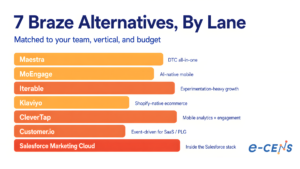
Mutual authentication and cryptographic signature verification are the security controls for this perimeter. Every webhook transmitted by the customer engagement platform must incorporate an HMAC-SHA256 signature header generated using a shared enterprise secret key. Inbound reverse proxies must validate this signature and reject any request with an invalid hash or a timestamp diverging by more than three hundred seconds from UTC, which blocks replay attacks. When evaluating commercial alternatives during platform selection, as outlined in our analysis of the 7 best Braze alternatives in 2026 matched to your team, vertical, and budget, engineering leaders must audit each vendor webhook retry policies, dead-letter storage retention windows, and egress encryption protocols to ensure compatibility with enterprise security standards.
What Breaks During Phase 4 Template Migration and Dedicated IP Warming?
Phase 4 template migration is a precision exercise in templating syntax, binary payload limits, and mail transport infrastructure. Migrating communication templates and messaging logic from legacy systems into a modern customer engagement platform requires the same discipline. Simply duplicating existing HTML markup or notification copy into a new interface overlooks critical differences in templating syntax, binary payload restrictions, and mail transport infrastructure.
How Do You Optimize Dynamic Templates and Push Payloads?
Dynamic templates and push payloads are the two migration surfaces governed by templating syntax and binary payload restrictions. Templating engines such as Liquid or Handlebars are the personalization layer inside customer engagement platforms. These engines provide immense personalization power and introduce severe runtime risks when template logic lacks defensive fallbacks. An email template that renders personalized user properties without an explicit default filter can throw rendering exceptions from an unpopulated database field, which halts batch dispatch jobs. All production dynamic templates must implement strict defensive syntax with fallback defaults.
Binary payload boundaries are the hard constraint on push notification dispatches. Apple APNs strictly enforces a maximum payload size of 4096 bytes (4KB) for standard alert notifications and 5120 bytes for background or VoIP notifications. Google FCM similarly enforces a 4096-byte limit on data payloads. Any notification payload exceeding these limits is immediately rejected by push gateways. Engineering teams must implement character budgeting and automated truncation algorithms within template pipelines when push notifications include dynamic personalization, product catalogs, and deep-link parameters, replacing bulky JSON objects with concise resource IDs.
Dedicated Email IP Infrastructure and Methodical 30-Day Warming
Email transport initialization is the most critical deliverability failure mode in customer engagement platform implementations. Major Internet Service Providers and mailbox providers (including Google Gmail, Microsoft Outlook, Yahoo, and regional telecoms) assess incoming email streams using statistical reputation models trained on historical sending IP and domain behavior. When an enterprise abruptly routes millions of marketing emails through newly provisioned dedicated IP addresses, mailbox security systems classify the surge as compromised server activity, immediately routing messages to spam folders or issuing temporary SMTP deferrals.
Superior inbox placement depends on provisioning dedicated IP pools through enterprise email delivery infrastructure (such as SendGrid, SparkPost, or Amazon SES) and executing a structured, thirty-day IP warming schedule. The implementation begins with foundational DNS authentication (publishing SPF, DKIM with 2048-bit keys, DMARC with p=reject, and BIMI) and proceeds through strict volume escalation tiers:
| Warming Window | Daily Send Volume (per Dedicated IP) | Target Audience Cohort | Maximum Allowed Bounce Rate | Maximum Allowed Spam Complaint Rate |
|---|---|---|---|---|
| Days 1 to 3 | 50 to 500 Emails | Hyper-engaged users: opened or clicked email within last 7 days. | < 0.5% | < 0.02% |
| Days 4 to 7 | 1,000 to 2,500 Emails | Active users: engaged with email within last 14 days. | < 0.8% | < 0.03% |
| Days 8 to 14 | 5,000 to 15,000 Emails | Recent users: engaged with email within last 30 days. | < 1.0% | < 0.05% |
| Days 15 to 21 | 25,000 to 60,000 Emails | Moderate users: engaged with email within last 60 days. | < 1.2% | < 0.06% |
| Days 22 to 30 | 100,000 to Full Production | Standard marketing segments: engaged within last 90 days. | < 1.5% | < 0.08% |
Doubling volume every 24 to 48 hours while monitoring bounce rates and spam complaints is the escalation pattern that trains mailbox algorithms to recognize the IP as legitimate. Throughout this thirty-day progression, deliverability engineers must monitor telemetry within Google Postmaster Tools and Microsoft SNDS daily. If spam complaint rates cross 0.08% or if a mailbox provider issues SMTP 421 or 451 rate-limiting deferral codes, the warming schedule must halt volume increases immediately, holding volume flat or dialing back daily dispatches by 30% for three consecutive days until reputation scores recover.
How Does Phase 5 Govern Consent State and Preference Center Design?
Phase 5 consent governance is the compliance layer that spans the European Union General Data Protection Regulation (GDPR) and the California Consumer Privacy Act (CCPA/CPRA). Continuous adherence to those mandates, including regional data residency laws, is the 2026 operating requirement for an enterprise customer engagement platform. Violating customer consent preferences exposes organizations to severe financial penalties and permanently damages brand credibility. Consent must be architected as an active, synchronized state machine operating across all customer touchpoints.
Architecting Granular, Omnichannel Preference Centers
A granular omnichannel preference center is the self-service control surface for consent. Binary all-or-nothing unsubscribe links no longer meet enterprise standards or consumer expectations. Modern engagement platforms must host an intuitive, self-service preference portal accessible via web and mobile interfaces that separates transport channels from communication topics. Channel and topic decoupling gives consumers precise control over how and when they interact with the brand, which reduces global opt-out rates.
The preference center architecture must enforce four core dimensions of consent governance. Independent channel-level controls are the first consent dimension: Email, Mobile Push, SMS, In-App Messages, and WhatsApp. Topic-based categorization separates promotional discounts from weekly curated content. Cadence and snooze controls let subscribers limit message frequency or pause communications for thirty days. Immutable transactional exemptions ensure password reset tokens and purchase receipts bypass marketing filters.
Real-Time Bi-Directional Consent Synchronization and Erasure Compliance
Real-time consent synchronization is the mechanism that closes the latency window between an unsubscribe event and journey dispatch. A dangerous regulatory exposure occurs when an individual updates their preferences in one system and that change fails to propagate across the enterprise technology landscape. A customer who unsubscribes from SMS notifications via an incoming text keyword (“STOP”) can still receive an automated marketing journey dispatched during a twelve-hour latency window, which violates statutory regulations.
An event-driven consent synchronization pipeline is the prevention mechanism for this failure mode. When a preference modification occurs within the preference center, SMS gateway, or customer support portal, the updating system publishes an immediate consent_updated event to the central message broker. Downstream consumers, including the customer engagement platform, enterprise CRM (such as Salesforce or HubSpot), and data warehouse tables, ingest and apply the state update in sub-second latency. Automated engineering workflows must satisfy GDPR Article 17 (“Right to Erasure”) and CPRA deletion requests, purging customer records across all endpoints within thirty days and generating cryptographic receipts for enterprise compliance audit logs.
How Do You Cut Over to Production with Load Testing and Canary Releases?
Production cutover is the final phase of platform implementation and bridges pre-production testing with full-scale live execution. Migrating millions of active consumers to a new engagement engine without thorough stress testing introduces immense operational risk. Engineering organizations must validate system resiliency through synthetic load simulation, phased canary traffic migration, and exhaustive operational monitoring.
Synthetic Load Simulation with k6 and Locust
Synthetic load simulation with k6 or Locust is the pre-cutover capacity test. Testing environments must simulate three times the peak projected transactions per second (TPS) anticipated during the enterprise’s highest-volume annual sales events.
Load testing scenarios simulate thousands of concurrent virtual users executing realistic digital journeys: browsing catalog pages, adding items to cart, authenticating, and triggering transactional webhooks. Telemetry instrumentation evaluates three essential metrics under stress: ingestion API throughput sustaining 99.99% success rates with p95 response latencies below 150 milliseconds; dead-letter queue routing verifying that transient downstream 503 or 429 errors trigger exponential backoff without pipeline stalls; and end-to-end trigger dispatch latency remaining strictly below 500 milliseconds under full synthetic load.
Canary Deployments and Documented Enterprise Case Evidence
Canary deployments are the gradual release mechanism for the final phase. Production cutover must proceed through a phased canary release rather than an abrupt all-at-once migration. The migration begins by routing 1% of production user traffic to the new platform while the legacy system continues servicing the remaining 99%. Engineering and marketing teams monitor application performance, crash rates, webhook error rates, and user engagement metrics for forty-eight hours. If telemetry remains nominal, traffic routing scales progressively to 5%, 25%, 50%, and ultimately 100%.
The commercial value of executing this disciplined implementation methodology is proven by documented enterprise case evidence:
- Mimojo (Fintech Cashback Ecosystem): Mimojo, an innovative fintech startup offering frictionless cashback rewards on bank card purchases, experienced significant user onboarding drop-off, email deliverability issues, and stalled transaction volume following their initial uncalibrated MoEngage rollout. Partnering with e-CENS to execute an architectural overhaul, Mimojo fixed critical data tracking gaps, automated onboarding journeys for users who installed without signing up, and triggered real-time behavioral nudges for users who linked cards without transacting. The structured re-implementation produced a 200% increase in sign-up completion rates and an immediate 122% uplift in first transactions.
- Alsaif Gallery (Saudi Retail Enterprise): Alsaif Gallery, a premier Saudi kitchenware and home appliance retailer, struggled with siloed data systems that prevented personalized communication across digital touchpoints. Collaborating with e-CENS, Alsaif Gallery integrated MoEngage analytics, unified fragmented consumer profiles, and deployed automated lifecycle campaigns. During their major Black Friday commercial campaign, hyper-targeted segmentation generated a 196% revenue surge. Concurrently, their automated “N days no visit” lapsed customer win-back sequence achieved an unprecedented 57.19% conversion rate, while digital daily active users (DAUs) surged by 58% across their omnichannel ecosystem.
Enterprise customer engagement platforms are not mere promotional message dispatchers. When engineered with clean data schemas, resilient streaming pipelines, and disciplined performance monitoring, they function as scalable revenue generation engines.
Frequently Asked Questions About Enterprise CEP Implementation
How do engineering teams prevent mobile application performance degradation when embedding heavy CEP SDKs?
Asynchronous initialization off the main thread is the primary protection for mobile application responsiveness, supported by local queueing. Telemetry batches flush every thirty seconds or fifty events from an encrypted SQLite or Room database, which prevents main-thread blocking, conserves CPU cycles, and protects device battery reserves.
What is the recommended fallback strategy when real-time streaming ingestion pipelines experience backpressure?
A durable message broker is the backpressure fallback. When platform APIs return HTTP 429 or transient partitions appear, Kafka or Kinesis buffers traffic while consumer workers apply exponential backoff with full jitter. Records that fail five retry attempts route to a cloud-backed dead-letter queue (DLQ) for inspection and replay.
Why is a 30-day IP warming schedule non-negotiable for new enterprise CEP email deployments?
Historical domain and IP reputation are the scoring inputs that mailbox providers apply to inbound volume. A cold IP that suddenly transmits hundreds of thousands of messages triggers spam filtering and SMTP deferrals. A thirty-day ramp starting at 50 to 500 emails daily to the most engaged subscribers trains mailbox algorithms to treat the IP as legitimate.
How does a preference center architecture maintain synchronization between the CEP and enterprise CRM under GDPR and CPRA?
The consent synchronization requirement is an event-driven pipeline. A preference change publishes a consent_updated event to the central message broker, and the CEP, CRM, and warehouse tables apply the opt-in state within one second. GDPR Article 17 erasure requests trigger automated deletion webhooks that purge records within thirty days.
Transform Your Customer Engagement Architecture with e-CENS
Deploying an enterprise customer engagement platform is a decisive engineering undertaking that shapes your organization’s customer retention capabilities for years to come. Navigating complex identity graphs, streaming event pipelines, mobile SDK performance budgets, and strict privacy regulations requires deep technical expertise and proven implementation playbooks.
At e-CENS, we partner with enterprise brands worldwide to architect, implement, and optimize customer engagement infrastructure. From conducting rigorous pre-implementation technical audits and designing canonical data schemas to managing seamless production cutovers and calibrating cross-channel messaging engines, our team ensures your technology investments generate measurable enterprise ROI.
Ready to engineer a scalable, high-performance customer engagement platform? Contact e-CENS today to schedule an enterprise architecture consultation with our principal data strategists.